
UX Research in 2026: When AI Takes the Work and Leaves Us the Weight
Research
Daniel Mitev
12 min
Jan 31, 2026
The Lyssna research panel recently surveyed 100 UX researchers to map the landscape for 2026. This data confirms a shift I have felt in my own work: the mechanical parts of the job are being automated, leaving the strategic weight entirely on our shoulders.
Why this moment feels different
Lyssna surveyed 100 UX researchers in December 2025 to understand where the discipline is heading. The numbers are clear. The implications take longer to absorb.
AI-assisted analysis is no longer an experiment.
Synthetic users are no longer theoretical.
Research is no longer owned by researchers alone.
What surprised me was not the direction of change.
It was how cleanly the work itself is being separated from the responsibility that comes with it.
Automation is absorbing execution.
Judgment is becoming unavoidable.
The state of UX research in 2026, without the noise
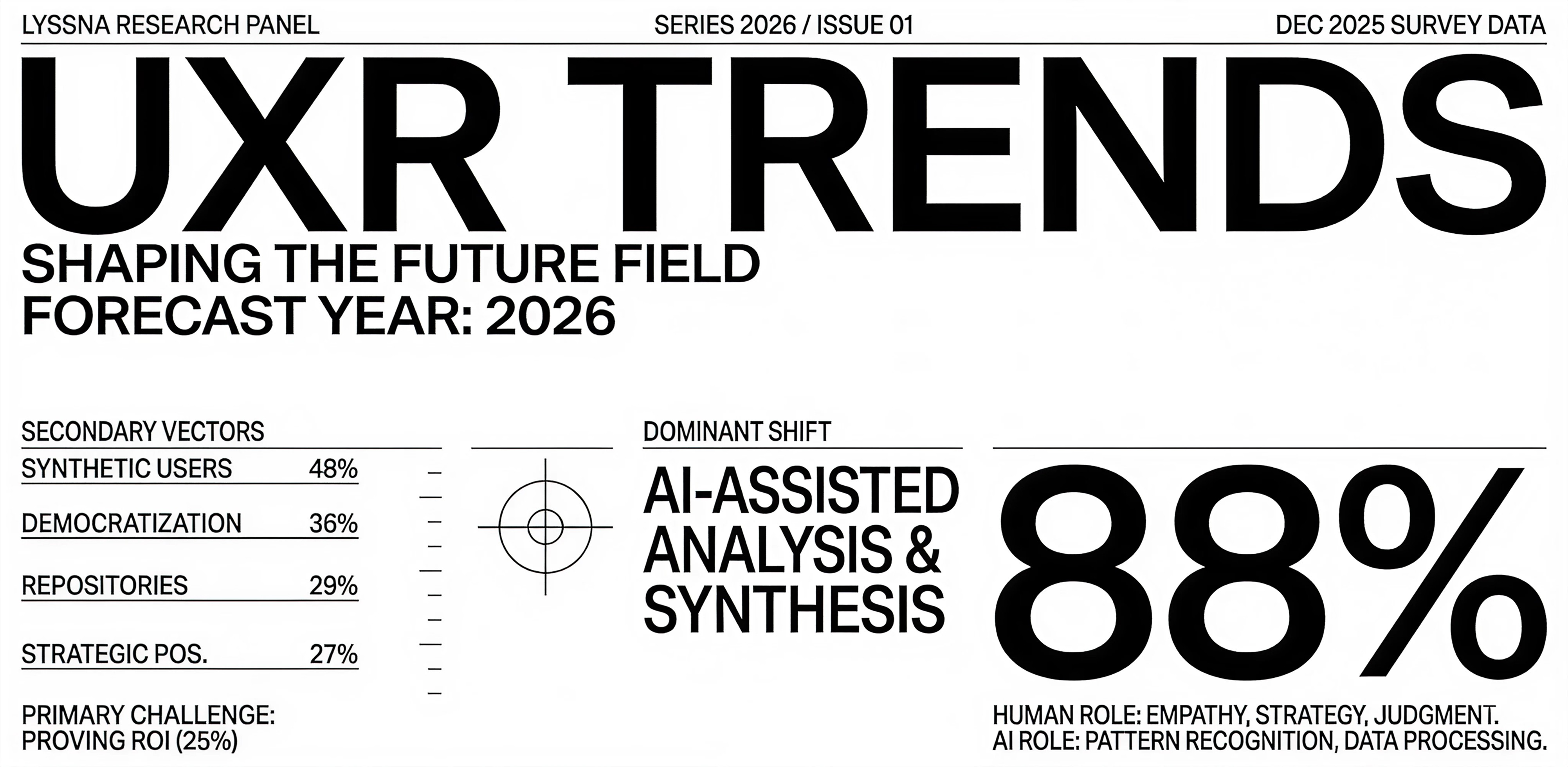
Four signals matter more than the rest.
AI is now baseline
88 percent of researchers already use AI-assisted analysis and synthesis. Transcription, tagging, and first-pass patterning are moving into automation.
Synthetic users are entering the workflow
48 percent expect synthetic participants to have an impact, with visible skepticism about where they belong.
Research is democratizing
36 percent see non-researchers running studies, enabled by tools and AI.
ROI remains unresolved
25 percent still struggle to prove research value in business terms.
None of these signals exist in isolation. Together, they describe a profession shedding volume and gaining consequence.
How AI actually changes research work
AI handles frequency.
Humans handle significance.
According to Lyssna’s data, 23 percent of researchers already use AI to find patterns. That number will rise. The risk is not speed. The risk is mistaking recurrence for relevance.
AI is excellent at answering:
What happened most often
Which themes cluster together
Where users hesitate repeatedly
It struggles with:
Why a rare behavior matters
When a contradiction signals opportunity
How context reshapes meaning
Innovation lives in the second group.
In 2026, strong research is defined less by how fast insights appear and more by whether someone knows which insights deserve attention.
Where synthetic users fit, and where they do not
Synthetic users are mirrors of historical data.
They work when the mental model is already known.
They fail when discovery is required.
Lyssna’s respondents captured this tension well. Some expect synthetic users to help with speed and cost. Others expect disappointment once nuance is required.
A synthetic participant can validate:
Known usability patterns
Established interaction flows
Basic comprehension checks
It cannot surface:
Emotional shifts
Life events
Behavioral contradictions
Contextual risk and trust dynamics
When used early, synthetic users flatten insight. Products become technically correct and experientially shallow.
This is how teams design for users who resemble people, but never behave like them.
Why ROI remains the hardest problem
The data is blunt.
One in four researchers still cannot prove value.
This is not a tooling issue.
It is a translation issue.
Research often stops at insight. Business decisions require consequence.
Usability findings rarely move a boardroom.
Operational impact does.
In 2026, research survives when it connects to:
Churn reduction
Support volume decline
Conversion confidence
Time-on-task improvement
Risk and error prevention
The role is shifting from insight generator to decision amplifier. Research that does not change outcomes becomes informational. Research that does becomes strategic.
Who owns research now
Ownership is moving away from execution.
Democratization is not a threat. It is a redistribution of effort.
As designers, PMs, and engineers run tests, the researcher’s value concentrates elsewhere:
Framing the right questions
Designing sound methodology
Maintaining rigor under speed
Building repositories and systems that preserve learning
Lyssna’s data shows growing interest in research repositories and ResearchOps for a reason. When data multiplies, governance becomes the work.
In 2026, authority comes from stewardship, not volume.
What the profession is shedding
The busywork is leaving.
Manual transcription.
Endless tagging.
Mechanical synthesis.
These tasks once justified time. They no longer justify value.
What remains is closer to the core of the discipline:
Human judgment
Contextual interpretation
Strategic framing
Decision clarity
AI accelerates output.
It does not create meaning.
That responsibility stays human.
How to prepare, without chasing tools
Lyssna’s recommendations point in the right direction, but the underlying shift is simpler.
Learn AI as infrastructure, not identity.
Tie insight to business consequence.
Build systems that outlive individual studies.
Protect rigor while moving faster.
The researchers who thrive will not be the fastest operators. They will be the clearest thinkers.
Closing reflection
UX research is not being replaced.
It is being exposed.
As automation removes the comfort of labor, the profession is forced back to its fundamentals. Understanding people. Interpreting ambiguity. Making decisions when certainty is unavailable.
The machines now provide the data.
Our careers depend on what we do with it.
Read more:

AI Integration in UX Design: Enhancing User Experiences

Unlocking Success: How a UX Strategy Consultant Transforms Brands

Building AI Products with Great UX: Mastering the Text Prompt

How Can We Reduce Stress for Users?

Why UX Is Moving From Execution to Judgment

UX Research in 2026: When AI Takes the Work and Leaves Us the Weight

The Quiet Shift Changing UX
Synthetic users: is there a place for “AI-generated users” in UX Research?

The Mechanics Behind Making Better Design Decisions

Is mobile-first approach killing your website’s potential?